
Today in Year Four Computing, our pupils took their next big step into the world of digital technology with Lesson 2 of our BBC Micro:Bit project – and it was all about building a Night Light!
Using the BBC Micro:Bit built-in light sensor, the children learned how to code a light that automatically switches on when it gets dark – just like a real control system. This hands-on project helped them explore how inputs (like sensors), outputs (like the LED light), and computer code work together in smart devices.
We also introduced a key new concept: conditional logic (IF/ELSE statements). Pupils discovered how computers use logic to make decisions, depending on whether something is true or false – for example, “IF it’s dark, THEN turn on the light!”
Alongside this, we explored how infinite loops (REPEAT FOREVER) are used in programming to make systems respond continually to their environment – a great way to deepen our understanding of how computers interact with the real world.
Today’s success criteria:
I can code a Micro:Bit to make a light that switches on when it gets dark using sensors and logic.
I can explain that sensors are inputs that sense things in the real world.
I can explain how computers make decisions using true/false logic.
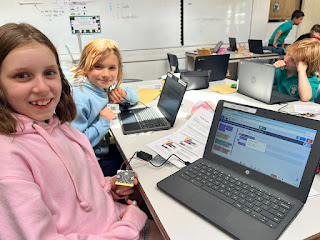

Our pupils are doing brilliantly with their coding adventures and showing real curiosity about how technology shapes the world around us.
👉 Don’t forget: please return your child’s full Micro:Bit Home Learning Pack every Monday, so we can continue building on this fantastic progress in class.
For any questions about the project or to find out more, feel free to contact Mr. Spracklen at:
📧 headteacher@princeofwales.dorset.sch.uk
Keep coding, Year Four! 🚀

No comments:
Post a Comment